
What is 'the Ballot'
The least expensive way to play the Old Course Is through ‘the Ballot’. The ballot is basically what it sounds like, a random lottery drawn 48 hrs before play.
We enter names in a two, three or fourball application, and if we match the random number generator, we all play. Although our prospects of winning a ballot on any given day are usually odds against, we can build-up our chances by making a series of applications over a number of days. In it’s crudest explanation, we run the numbers game, so as to try and tip the balance in our favour by sheer weight of attempts.
What are the Chances of Winning the St Andrews Old Course Ballot? is the question everyone wants to know the answer to. No one can ‘lock you in’, but we can potentially load the dice in your favour by being smart. It’s about understanding supply and demand, as well as a bit about human nature.
Any golfer qualified by handicap (36)
In order to enter, we’ll need the following
- Golfers names
- Golfers Handicaps
- Gender (if it isn’t obvious)
- Name of Club
The name of the club is the parameter that causes the most confusion, as not everyone maintains an active paid membership. What the St Andrews Links Trust (SALT) are predominantly after is the body that sanctions your handicap. It could be an App, or it could be an affiliation to a State Golf Association
With both gentlemen and ladies now being required to present the same handicap number (36) we aren’t sure why they ask for gender. It’s probably a legacy question, but until the SALT recode the on-line system we have to tick the box to complete the process
Single golfers can’t enter the ballot. Instead we need to try match single golfers with other golfers to form a minimum of a two-ball to allow any entry to proceed. Anyone trying to enter as a single simply wouldn’t be permitted to complete the process (the computer rejects the application)
One (for each 24 hr cycle)
It doesn’t matter if you know other golfers who’ve invited you to play with them as well. If your name is allowed to appear in both entries, you’ll get both entries disqualified. You will need to choose which entry to ‘go with’
Critically a fourball enters as one fourball. You don’t enter four times submitting one each. That’ll get all your applications disqualified as well.
Be suspicious of anyone who claims to have achieved things outside of the rules. Some golfers like to ‘impress’ and can claim to have pulled a stunt that in all probability they likely haven’t done
A ballot for tee-times on the St Andrews Old Course is drawn every day that the Old Course is open for visitor play. This excludes Sunday when it’s closed, and any ‘blocked out’ dates for other events/ commitments
A ballot cycle begins about an hour after the results of the previous ballot are published. Maybe the best way to illustrate it is a working example, we’ll use a hypothetical Thursday
The results for play the previous day (which would be a Wednesday in this example) will be published at about 16.30 on Monday. We can now enter Thursday’s ballot any time between Monday from about 17.00, until Tuesday the following day, up until 14.00. There is a hard deadline of 14.00 at the 48 hrs stage
At 14.00 the entries lock, and the names are drawn by a random number generator (RNG). The results are published the same day at about 16.30 (Tuesday in this example) for play on Thursday, and the next ballot opens again at 17.00 for play on Friday
We enter as a group. So if Mr Brown, Mr Black, Ms Green and Ms White enter as a fourball, they’ll be given an entry number by the RNG (we don’t know what that number is). If it matches the drawn number, then everyone will play together as a fourball
The cost of the green fee is the prevailing retail price at the time. This is paid by you to the Links Trust. There are no penalty charges or hidden extras on the Ballot
You shouldn’t be expected to pay an entry/ admin fee. Certainly Faraway Fairways don’t charge one, and we’d be surprised if any Golf Tour Operator does
The likelihood of failure on any given day however means we need to adopt a contingency. This involves booking another course as a fall-back option, which Faraway Fairways will then cancel on your behalf when you’re successful through the ballot. Green fees for the cancelled course are forfeited under this arrangement, although the course concerned will always look to reschedule, and more often than not they’ll be able to do so.
A big part of this management challenge is to try and construct an itinerary that doesn’t leave us exposed to expensive forfeits whilst also seeking quality replacements by way of our ‘plan B’. As you might imagine, the two ambitions are in something of a conflict with each other given that the more expensive courses tend to be the better-quality ones too.
In twelve years, Faraway Fairways has only ever lost two courses for failure to recover them against a ballot win. Once at Carnoustie, and once at North Berwick. Even the Carnoustie one was a calculated gamble as we knew there was no escape route, but the clients said they’d rather launch one ‘hail Mary’ on what was their last throw of the dice (and they won it)
The St Andrews Links Trust (SALT) publish a busy dates diary in their website that identifies ‘blocked out’ days and times for the Old Course. Golf Tour Operators (GTO’s) and members of the public consult this and make decisions accordingly. The SALT don’t message us when a new date is added though. They just expect us to find it, so it’s never a bad idea to sweep through the diary in Oct to check for the following season
Some dates reoccur every year such as the first week of May, first week of June, and the run from mid Sept to early Oct. These are best avoided as supply is very low, but the relationship between supply and demand is complex and speculative and to some extent we have to understand human nature to try and second guess it.
Success through the ballot is the product of the ratio of supply and demand, and not necessarily a supply-side function on it’s own. To understand this, we need to have a grasp of human nature and can probably illustrate it using a hypothetical example
Assume we have 1,000 golfers all looking at the availability schedule and considering the same week
- Week ‘A’ has 6 clear days with 16 times each = 96
- Week ‘B’ has 4 clear days with 16 times each = 64
- Week ‘C’ has 2 clear days with 16 times each = 32
Which would you choose? Now run this decision a thousand times over and what do you suppose happens?
So let’s assume other factors weigh into the decision and we ultimately get 600, 250 and 150
- Week ‘A’ has a ratio of 1 to 6.25
- Week ‘B’ has a ratio of 1 to 3.90
- Week ‘C’ has a ratio of 1 to 4.68
Golfers targeting Week ‘B’ are the most likely to succeed. A prima facie favourable window can get over-subscribed to the point where it becomes unfavourable
The thing is though, we don’t know what these numbers are. All we know is what might happen, but then we have to guess a bit.
We should stress (and this is important) is that we believe this relationship has weakened post covid. Demand has been such that even poor windows are drawing in quite a lot of traffic, especially from local players who don’t need to worry about the machinations of finding a sweet spot
Our advice is still to follow a strong line of supply, but don’t be afraid to take on a slightly weaker one if its surrounded by what looks like better windows. Going against the crowd (or skating towards where the puck is going) can bear fruit
Green fees need paying in advance and are always non-refundable against a certain timeline
Green fees need paying in advance and are always non-refundable against a certain timeline
A St Andrews Old Course ballot is drawn 48 hrs before play, and we can safely assume that this is outside any refund window! Any win in the ballot therefore will send us into a clash with which ever course we had booked that day, and we’ll a loss of the green fee unless we can get the tee-time rearranged. For this reason we don’t necessarily want to fill every day of the week up with a paid green fee and golf course. That would be designing a forfeit (we are after all setting up to win a ballot and play the Old Course)
Luckily the St Andrews New Course can’t be prebooked, and every other tee-time after 09.00 is offered present-pay-and-play-on-the-day. This is a great way of putting a placeholder into the itinerary without taking on the liability of a prepaid green fee
We try to schedule the New Course in any St Andrews swing to max out this position. If we win a ballot on the day we were going to try and play the New Course, we simply play the Old Course instead. If we win a ballot on another day, then we look to reschedule the affected course onto the day we had the New Course inked in and avoid a forfeit that way. We’ll usually try and put the New Course last in an itinerary then to give ourselves the maximum length of runway onto which we might land the rearranged round
Perversely perhaps, we’re actually hoping not to play the New Course. The reason we wouldn’t play it, is because we’ve won a ballot and are playing the Old Course instead
As we’ve noted above, we try and slot the St Andrews New Course last, since this is tantamount to a ‘floating’ course that we haven’t paid for. It means we can either slide the Old Course into without penalty, and seek to rearrange any courses that were cancelled earlier in the week to make space for our Old Course round, onto this floating day, be that through one step swap, and a two step shuffling of courses. Strategy doesn’t stop with this though
Not all courses rearrange with the same ease. Carnoustie and North Berwick are the two most difficult to rearrange should we go into a clash with either. The safest way to eliminate any chance of a forfeit is to try and place them on Sunday, the one day of the week when a ballot isn’t drawn, and so with a single stroke we can remove the threat of a green fee forfeit for failure to rearrange by putting them safe. If there is a known blocked out during the week concerned, we can use that to shelter under as well
As a general rule, the more expensive the green fee (Kingsbarns) or difficult the course is to rearrange, we try to play them earlier in our run than later. If for example we slot Kingsbarns for Tuesday and we win a ballot for the same day, then we’d typically have Weds, Thurs, Fri, & Sat on which to find a new tee time. This much easier to do than if we’d lined up Kingsbarns for Friday, and would only have the Saturday on which to bail out
The SALT don’t publish ballot data. We have to rely on other sources to scavenge it. This means we’re often dealing with imperfect scraps and are required to perform manipulations, extrapolations and projections based on working hypotheses. In addition to this, we’re also able to draw on our own evidence, and that which we’re able to extract from credible co-operative partners (usually hotels) plus what other tour operators might tell us.
This is what we believe the situation to be post covid
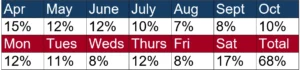
As you can see, Saturday is the most productive day of the week, followed by Thursday. A considered ballot strategy ought to look to put both days on-side, although Faraway Fairways has noticed a small uptick in the number of ballots we’ve been winning Mon – Weds, which does make us wonder if the ‘word is out’ and golfers are just starting to over-subscribe the prime days?
Now there is a complex (and crude) extrapolation and forecast we can produce based around seasonal averages and variance from the median, since ultimately every monthly figure is the result of a cumulative daily performance that goes to make up that months performance, but that sort of thing isn’t best dealt with here and the sort of thing we do in a proper proposal instead
There many different ways a GTO might legitimately seek to present ballot or Old Course success rates that it’s actually quite difficult to know which is the fairest to use?
The abolition of the walk up rule in 2024 has rendered a lot of historic data meaningless now so it might be opportune to indulge in something of a reset in our reporting
The daily strike rate is a fairly straight-forward metric to understand, and we can present that without much of a caveat other than state it’s a seasonal average April to October.
One of the most corrupting influences in ballot data is the contribution made to it by golfer’s on very short durations (business trips or passing through etc). Realistically these golfers aren’t giving themselves a percentage chance, but they can certainly damage a GTO’s performance data. Perhaps the fairest metric to use is what we’ve called “golfers on a 4+ strategy” (highlighted). This captures golfers who made at least four attempts to play the Old Course through the ballot (the minimum we’d recommend) and a profile which better fits a majority of the enquiries we receive.
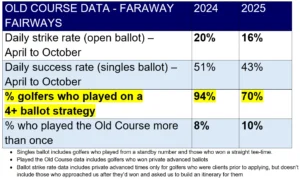
Although 2025 looks like a deterioration in performance, this is probably relative. 2024 was a particularly strong level of performance. We subsequently learned that the average strike rate was 10.5% so Faraway Fairways at 19.7% massively over-performed that. We’d imagine (if such a league table existed) that we had to be top-5
We don’t count players in the ‘golfers’ data who only made 3 open ballot and no single ballot attempts since they aren’t deemed to have given themselves a reasonable chance. We do count them in the ballot data however when success is reporting as a strike rate
Our 2025 performance was always going to struggle to match 2024.
2025’s performance was compromised by fewer golfers being prepared to use the singles ballot than that which we witnessed in 2024. Had they done so, we’d probably have enjoyed something closer to an 80% success rate of play. We believe the seasonal strike rate in 2025 was 11% again, so we’ve still over performed it, but not by as much
The ballot is a moving target, and its outcomes are often the product of information flows that alter golfers decisions. What used to work once, can stop doing so as the ‘word gets out’
The most recent trends we’ve seen in 2025 is many more local players are now contesting ballots than they used to. We think this is the product of golfers who took up the game in covid progressing from entry level courses to more challenging layouts
Pre-covid April enjoyed a significant edge of any other month of the year (strike rates were at least double the next nearest month). Post covid this advantage has disappeared. April only performs marginally better than May now we believe
We also think we’re seeing many more Chinese names appearing in tee-sheets too, which would be a concern for competition given the size of their population
No – you can’t change the name of a winner and nominate someone of your choosing to replace you. This is the question we probably get asked the most frequently outside of the strike rates. If the SALT permitted this, they’d set off a speculative resale market. Old Course tee-times have a market value and the ballot would be flooded by locals or bots asking for crypto payments
No – you can’t move your tee-time or swap with someone else. If you don’t want the time, then the SALT will have little difficulty replacing you
No – you can’t make multiple applications using spelling variants or different name submission orders. You will still be nominating the same handicap and affiliated club, this alone should betray a duplicate and lead to all your applications being disqualified. You won’t be told that you’ve been disqualified, so you’ll never know.
We often hear people saying that they ‘know someone, who knows someone, whose a member of the R&A’. Unless R&A members do nothing else all year than trying to facilitate tenuous friendship chains onto the Old Course, this is unlikely to work. The only time in over 10 years we’ve seen a friendship contact breakthrough a barrier was once at Royal County Down and once at the Renaissance Club. Never seen anyone actually make it work for the St Andrews Old Course
No – two-balls aren’t favoured. You might however hear that they are. This is because ‘every other two ball is indeed made up to fourball’ but critically, it doesn’t mean there is a separate pot of two ball applications drawn alongside other two balls. That’s not how it works. The best way to illustrate this is an example.
- A two ball is drawn for 06.30 and goes into the tee-sheet
- A second two ball is drawn for 07.20 and goes into the tee sheet
- A third two ball is drawn for 08.10, but rather than going into the tee-sheet for 08.10, they moved down onto the 07.20 time to form a fourball and the 08.10 time is drawn again
- If a two ball wins the 08.10 again, they go into the tee-sheet, as indeed would any playing group that comes out the draw next
This process repeats all the way down the tee-sheet as alternate two balls are made up to fourballs, but by doing it this way, two ball applications aren’t handed an advantage since the draw onto the vacated time is still random
No -the Ballot isn’t rigged. If it were ever possible to get a ‘favour’ in the distant past, it isn’t anymore. Golf travel is too much of an industry today. The SALT would be laying themselves wide open to a legal challenge if they got caught doing anything underhand
No – you can’t bribe the Starter

Testimonial

From LW from Canada
“Trusting someone to create a 30 day itinerary was scary, and after talking with several well-known companies, we started getting frustrated as none of them seemed to be able to put together quite what we wanted. Then we called Faraway Fairways and everything seemed to click. We loved every aspect of our trip, and we owe it all to Alun and his meticulous planning and personal attention. ”

From TM Georgia
“My family had a wonderful experience in large part because your team selected such meaningful balance of historical, cultural, and golf experiences. I can’t thank you enough for this terrific experience.”

From BB Canada
“I told Alun the courses I was interested in playing and he prepared a stay and play package with 14 days of outstanding golf, but also tremendous site seeing opportunities for my wife.”

From JC Illinois
“His attention to detail is amazing--I think our travel plan booklet ran to forty-eight pages, with gorgeous descriptions of cities and sights, plus maps showing where to go to catch trains, or walk from trains to hotels, sights and golf courses, etc.”

From DF Alabama & Pennsylvania
“I will cherish the memories for a long time- especially the wonderful times spent on and off the golf course with two of my brothers and brother-in-law. None of the memories and golf would have been possible or enjoyed without your tremendous planning and logistical support.”

AS from Colorado
“Alun and Faraway Fairways created possibly the most memorable golf trip we have ever experienced. EPIC is the only word that comes to mind.”

AC, From Florida/ New York, 2025
“We were hopeful to secure a 4 ball at St. Andrews while avoiding the massive expense other operators had quoted. He was very clear about the plan for achieving a tee time at the Old Course through the ballot, including detailed instruction on how it could be done, and what our odds were. He suggested mid- to late April as the best chance of success and advised that this is also the least rainy part of the year. We took his advice and trusted the process. Well, he was right on all counts!”

From SB, Minnesota
“We wholeheartedly recommend Alun and Faraway Fairways if you’re looking for a golf trip that is effortless, enjoyable, and truly unforgettable—even for a non-golfer in the mix! My husband and I will be daydreaming about this trip for years to come. 5.5 stars!”

From JB, California
“The best part was that the service was surprisingly affordable. They were thousands of dollars below other quotes that I received, in fact the prices were very similar to what I would have paid if I would have booked everything on my own.”

From JCA, Maryland
“I would and will highly recommend your company to anyone looking to plan an unforgettable golf trip. Thank You for putting together a fantastic trip for J.C. and me”

From WF Connecticut
“I think all eight of us would agree that Alun at Faraway Fairways did an absolutely wonderful job of putting this “golf vacation of a lifetime” together for us. His focus on the details was extraordinary from the choice of courses and the timing of the tee times, the amazingly beautiful accommodations along with some excellent meal selections, and the transportation options he provided to get us from place to place.”

From DR South Carolina
“You are about to tee it up in your Major. Seek wisdom, integrity and professionalism. Alun Davies and Faraway Fairways will not disappoint you. They cannot assure a calm sunny day with temperatures in the 70’s on the Old Course.”

From MM, California
“One fantastic trip you organized, and more importantly took ownership of in terms of daily communication and stewardship during our 2+ weeks in Scotland and Ireland. The logistics were spotless…100% of the transports were on time and excellent, the lodging choices spectacular and the golf was off the charts in terms of quality and arrangements made”
DH from California
“You cannot go wrong with the support Faraway Fairways offered. I did this trip solo and all last minute but I have already begun to plan the next trip which will include my best golfing buddies. ”
Enquiry
We don't need to make this an ordeal by 101 filtering questions! In reality there are probably little more than half a dozen things we need to know to build out a proposal. The guidance below might help you frame answers
Duration - usually best expressed as a range up to a maximum
Time of year - can be anything from a specific date range to a named season
Travel class - Faraway Fairways uses 'Luxury', 'Premier' or 'Affordable' for generic purposes. You might choose to reference the international 'star' rating system. We're only looking for something to help steer us into the right sector
Self drive or hired driver - In broad terms, self driving is normally less expensive, and much more flexible, but some folk just don't want to do it
Must play courses/ must do places - a few name checks is all that's needed