
St Andrews, Carnoustie, Kingsbarns, Golf Vacation
St Andrews, Carnoustie, Kingsbarns, Dumbarnie, Gleneagles, with the St Andrews New Course, Castle Course & Jubilee Course
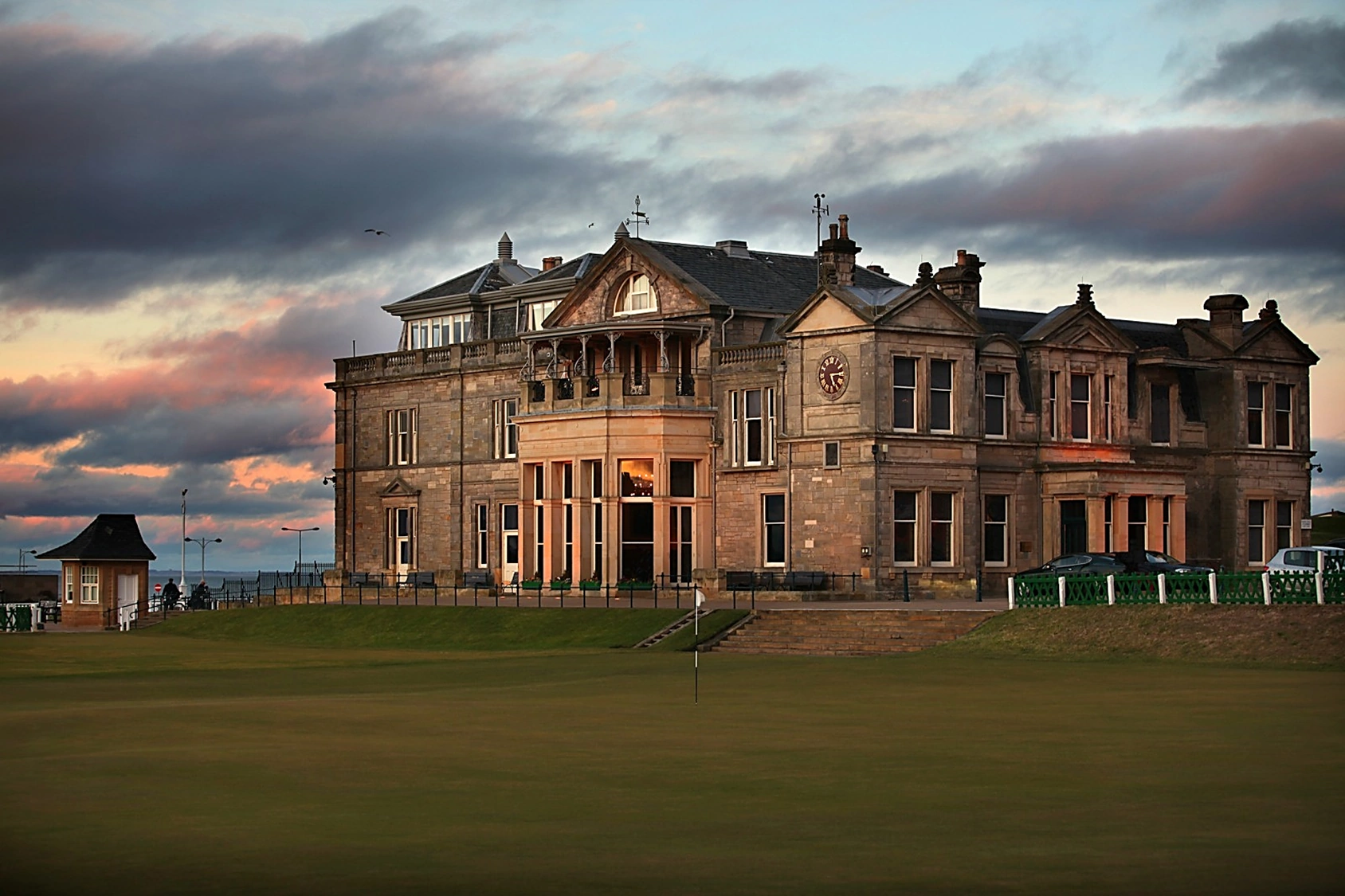
The Character
The St Andrews, Carnoustie, Kingsbarns, Golf Vacation is operates a daily back-to-base model centred on the town itself. This is a low mileage, and low to medium-low transport intensity, and one where we might consider using a hired driver without notable detriment in the price.
The St Andrews Old course needs no introduction. It is the home of golf, and the course we receive the most interest in.
Carnoustie is the toughest links course on the Open Championship rotation, a classic test that any golfer visiting Scotland will want to pit themselves against.
Kingsbarns makes up the trinity of established top-50 ranked links.
In 2020, Dumbarnie opened and quickly established as a peer and candidate for future world’s top-100 lists.
This quartet forms the core of the offer, whilst we’re able to sprinkle some modern and ancient around it as we seek to secure our coveted round on the Old Course
We therefore add the St Andrews New Course, sister track to the Old course, and probably the most complete test of a links golfer that St Andrews has to offer. The Castle Course offers some aesthetic drama, whist Gleneagles will lend us an unmistakable sense of grandeur and class
Itinerary
The majestic trio of courses at Gleneagles are a masterpiece of golf course design, which has caught the imagination of both professional and amateur alike. Lee Trevino remarked whilst standing on the first, “that if this is heaven I sure hope they have some tee times available”.
The regal King’s Course is certainly one of the most beautiful and exhilarating places to play golf in the world, with the springy moorland turf underfoot, the sweeping views from the tees all around, the rock-faced mountains to the north, the green hills to the south, and the peaks of the Trossachs and Ben Vorlich on the western horizon.
Threading through high ridges on the north and west sides of the estate, the Queen’s course is the most aesthetic of the Gleneagles trinity. It presents you with lovely woodland settings, lochans and ditches as water hazards, as well as many moorland characteristics.
Having hosted the 2014 Ryder and 2019 Solheim Cups, the Centenary Course is the longest and probably the most recognisable today. It plays out towards the dark glen, sweeping up the Ochil Hills to the summit of the pass below Ben Shee, which joins it to Glendevon. Course architect, Jack Nicklaus, described it as “The finest parcel of land in the world I have ever been given to work with”
World top 75 ranked
There are records of golf being played at Kingsbarns from 1793, but the modern course opened in 2000, and is set on three-tiered levels, sloping towards the coast. Nearly every hole has stunning views of the North Sea.
Kingsbarns quickly racked up rave reviews and earned a world ranking of about #50, a position which it’s held more or less since.
The par 5, twelfth hole that plays along the arching shoreline to an exposed green, and the par 3, fifteenth, which involves playing a tee-shot across the waves, are often considered to the courses signature assignments. It was the fourth and fifth that caught Tom Doak’s eye when he described as Kingsbarns
“as piece of construction work, Kingsbarns is one of the best projects I’ve ever seen. I wouldn’t have believed it, if I hadn’t seen it for myself”
Perhaps of greatest significance is the number of times it beats more illustrious neighbours in surveys amongst visiting Americans since its always immaculately presented.
Kingsbarns completes the trio of East Coast giants that host the European Tour’s Dunhill links challenge each year alongside Carnoustie and the Old Course.
‘The Castle’ is the newest addition to the clan St Andrews (if we require the qualification to be a new build – the Craigtoun Course was added in 2025 but was technically a management arrangement as the Trust took over the old Dukes Course from the hotel).
Set atop cliffs it’s perhaps more Pebble Beach, than Scotland, yet the course has successfully cultivated a links character. The elevation provides stunning vistas of the bay and town below, making it one of the most photogenic courses in the country. You won’t be the first person to pause and smile as you look down into the town of St Andrews itself with all the historic landmarks on the skyline and simply think Wow! The course is really quite dramatic as the sea can usually be relied on to put up a display of raw energy. The eighth and and the par 3, seventeenth, ‘the Braes’ are particularly awesome.
Dumbarnie opened in 2020, and looks to have replicated the Kingsbarns design with 14 of the 18 holes having unencumbered views of the sea due to it playing on a natural escarpment with 80ft of elevation on the site. A number of high tees are used to provide the drama of hitting drives out to the ocean. Unusually for a links, water has also been introduced, albeit mainly confined to burns rather than lakes. The fairways are wide and forgiving with driveable risk and reward par 4’s a particular feature of the lay-out. The fifteenth looks remarkably similar to the 7th at Valhalla.
The philosophy behind it is aimed challenging the thinking golfer rather than humiliating them through penalty; as course designer Clive Clark remarked
“I have yet to hear a golfer come in from his round and declare: I really enjoyed a great round of golf today – I only lost 6 balls and 3-putted five greens!”
In 2021 Dumbarnie was named the world’s best new golf course at the international world golf awards which you have to imagine will go some way towards securing its top-100 position as it begins to bed down and evolve.
The Jubilee in question was that of Queen Victoria. This course therefore dates to 1897. It’s a quite typical links for the area, threading its way through low dunes, and without any double greens. The raised tees afford the golfer stunning views across St Andrews Bay and the town beyond.
It was only in 1988 that the Jubilee course came of age when Donald Steel was asked to upgrade it, adding length, interest, and challenge to the layout. Slowly it started to build up a reputation and loyalty. Today most judges agree the Jubilee is St Andrews’s most underrated course. Some go even further and regard it has the toughest links in the family now.
World top-10 ranked & Open Championship venue
The precise identity of the St Andrews Course we play will depend on the outcome of the ‘open’ ballots and the singles ballots (no one is going to sell a ‘guaranteed’ package for such a short duration)
With all the usual disclaimers of a lottery being random, and there being no such thing as a certainty etc plus the variable factor of availability for the specific week chosen, our prospects of winning a ballot on this programme would otherwise be considered very strong if we sought to use every opportunity to do so
We should be able to contest a total of six open ballots (Mon to Sat) and four ‘singles’ ballot (Weds to Sat), for a total of ten. At the time of writing, (early 2026), Faraway Fairways can’t recall ever seeing anyone fail on a 6/4 strategy
If we fail, then we’ll look to use the St Andrews New Course as compensation under the present-pay-and-play-on-the-day protocol that exists
World top-50 ranked & Open Championship venue
Dubbed ‘Car-Nasty’, Carnoustie is considered by many to be the most difficult links in the Open Championship rotation
In recent years it has seen some dramatic finishes, none more so than in 1999 when Jean van de Velde took an eight at the 72nd hole to throw away the claret jug. Iconic images of him paddling in the notorious ‘Barry Burn’ have entered golfing legend. The final four holes are the hardest finish on the rotation. After the carnage of 1999 (6 over won) Sport Illustrated described it as
“a nasty antique that was brought down from the attic after 24 years …the rough was deeper; and the R&A made the fairways as narrow as an eel’s appendix scar”.
Whereas the eighteenth is the hole that has often generated the most drama. The par 3 sixteenth has the highest average scoring par 3 on the Open Championship rotation as indeed the closing four are the hardest. The Par 5, sixth ‘Hogan’s Alley’, is another famous hole with a punitive out of bounds fence running down it’s left
1999 Carnoustie reduced Sergio Garcia to tears after successive scores of 89 and 83
Testimonial
From TM Georgia
“My family had a wonderful experience in large part because your team selected such meaningful balance of historical, cultural, and golf experiences. I can’t thank you enough for this terrific experience.”

From BB Canada
“I told Alun the courses I was interested in playing and he prepared a stay and play package with 14 days of outstanding golf, but also tremendous site seeing opportunities for my wife.”

From JC Illinois
“His attention to detail is amazing--I think our travel plan booklet ran to forty-eight pages, with gorgeous descriptions of cities and sights, plus maps showing where to go to catch trains, or walk from trains to hotels, sights and golf courses, etc.”

From DF Alabama & Pennsylvania
“I will cherish the memories for a long time- especially the wonderful times spent on and off the golf course with two of my brothers and brother-in-law. None of the memories and golf would have been possible or enjoyed without your tremendous planning and logistical support.”
AS from Colorado
“Alun and Faraway Fairways created possibly the most memorable golf trip we have ever experienced. EPIC is the only word that comes to mind.”

AC, From Florida/ New York, 2025
“We were hopeful to secure a 4 ball at St. Andrews while avoiding the massive expense other operators had quoted. He was very clear about the plan for achieving a tee time at the Old Course through the ballot, including detailed instruction on how it could be done, and what our odds were. He suggested mid- to late April as the best chance of success and advised that this is also the least rainy part of the year. We took his advice and trusted the process. Well, he was right on all counts!”

From SB, Minnesota
“We wholeheartedly recommend Alun and Faraway Fairways if you’re looking for a golf trip that is effortless, enjoyable, and truly unforgettable—even for a non-golfer in the mix! My husband and I will be daydreaming about this trip for years to come. 5.5 stars!”

From JB, California
“The best part was that the service was surprisingly affordable. They were thousands of dollars below other quotes that I received, in fact the prices were very similar to what I would have paid if I would have booked everything on my own.”
From JCA, Maryland
“I would and will highly recommend your company to anyone looking to plan an unforgettable golf trip. Thank You for putting together a fantastic trip for J.C. and me”

From WF Connecticut
“I think all eight of us would agree that Alun at Faraway Fairways did an absolutely wonderful job of putting this “golf vacation of a lifetime” together for us. His focus on the details was extraordinary from the choice of courses and the timing of the tee times, the amazingly beautiful accommodations along with some excellent meal selections, and the transportation options he provided to get us from place to place.”

From DR South Carolina
“You are about to tee it up in your Major. Seek wisdom, integrity and professionalism. Alun Davies and Faraway Fairways will not disappoint you. They cannot assure a calm sunny day with temperatures in the 70’s on the Old Course.”

From MM, California
“One fantastic trip you organized, and more importantly took ownership of in terms of daily communication and stewardship during our 2+ weeks in Scotland and Ireland. The logistics were spotless…100% of the transports were on time and excellent, the lodging choices spectacular and the golf was off the charts in terms of quality and arrangements made”
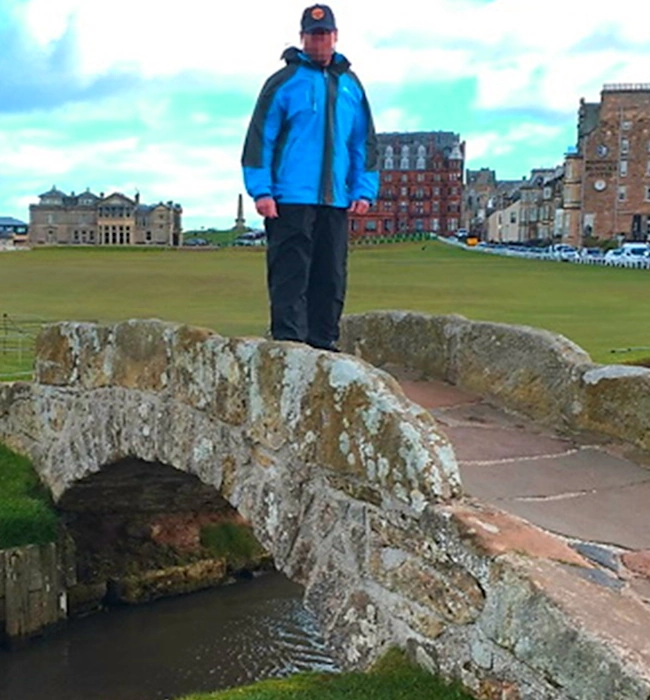
DH from California
“You cannot go wrong with the support Faraway Fairways offered. I did this trip solo and all last minute but I have already begun to plan the next trip which will include my best golfing buddies. ”
Enquiry
We don't need to make this an ordeal by 101 filtering questions! In reality there are probably little more than half a dozen things we need to know to build out a proposal. The guidance below might help you frame answers
Duration - usually best expressed as a range up to a maximum
Time of year - can be anything from a specific date range to a named season
Travel class - Faraway Fairways uses 'Luxury', 'Premier' or 'Affordable' for generic purposes. You might choose to reference the international 'star' rating system. We're only looking for something to help steer us into the right sector
Self drive or hired driver - In broad terms, self driving is normally less expensive, and much more flexible, but some folk just don't want to do it
Must play courses/ must do places - a few name checks is all that's needed